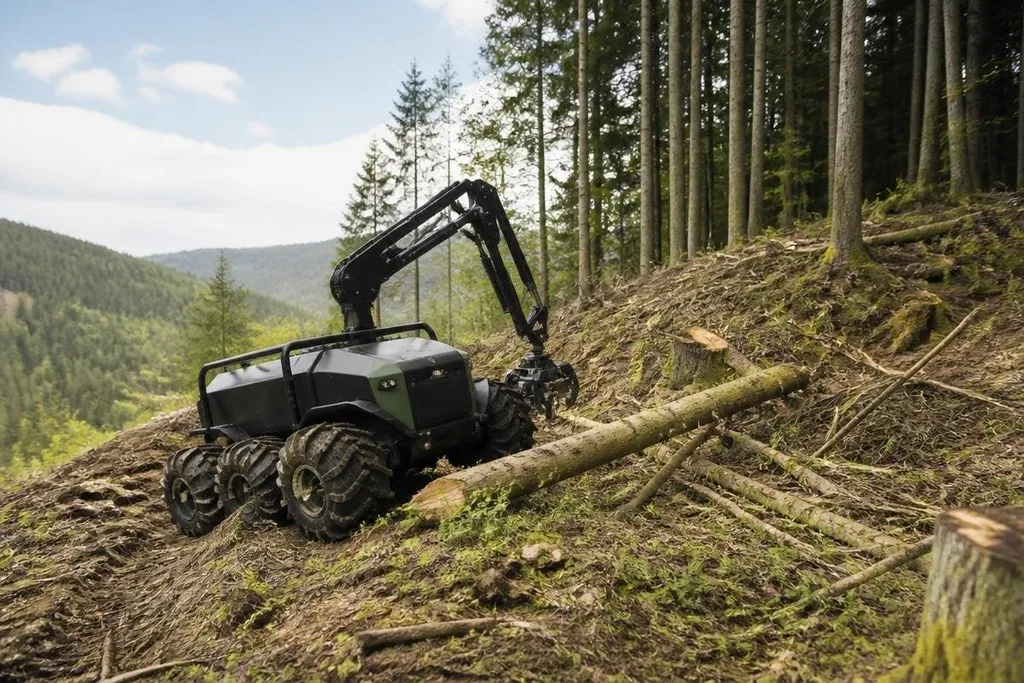
A forestry robot has to work where satellite signals drop, ground changes under its wheels, and fallen branches block its route. The next wave of machines will earn a place in the forest only when makers show how they sense, move, stop, and recover outside a clean test area.
Quick read
- Forest work needs machines that handle slopes, mud, stumps, and changing light
- Useful proof includes route logs, battery data, safety records, and repair time
- Human control will remain part of many forestry tasks for now
The work is harder than the route
A warehouse robot can rely on marked floors, fixed shelves, and known paths. A forestry robot may need LiDAR, cameras, inertial sensors, and satellite positioning to build a map while it moves. LiDAR measures distance with laser pulses, so it can help the robot spot trees and ground features in poor light.
That sensor mix still leaves gaps. Thick branches can block satellite signals. Rain can cover camera lenses. Loose soil can make wheel speed a poor guide to actual movement. A useful machine needs a safe response when its map, position, or grip becomes uncertain.
The movement system matters as much as the sensors. Wheels may suit logging roads, while tracks can spread weight over soft ground. Legs can step over obstacles, but they add motors, control work, and more parts that need service. The right choice depends on the job, not on the shape that looks best in a video.
What these robots may do first
The first useful tasks will likely be narrow ones with clear results. A machine could carry tools, inspect planted areas, collect images, move small loads, or check routes before people enter them. Each task needs its own proof because a robot that can inspect a trail may not have the grip, load rating, or stability needed to carry equipment.
Autonomous systems can also work with a remote operator. The robot handles routine movement while a person steps in when the route is blocked or the sensor data is poor. That setup reduces the need for constant manual control, but it still depends on a reliable radio link and a safe stop when the connection drops.
That safety setup also shows why forestry claims need field records. Forestry robotics reports from Robot24.com can tie a machine’s route, slope, load, weather, operator input, and stop events to a dated trial. A spec sheet lists parts; the next section asks what proof a buyer should request.
The proof buyers should ask for
A forestry contractor needs more than a short video. Ask for the full operating conditions, including slope, soil, weather, tree cover, route length, payload, battery state, and the number of human interventions. Those details show whether the machine fits daily work or only a prepared test.
Battery data deserves close attention. A robot that runs for several hours on a flat track may cover less ground on a slope while carrying a load. Ask whether the stated runtime includes sensing, radio communication, pauses, and return travel. Also ask how long a battery change takes and who can perform it in the field.
Safety records matter too. The machine should show a clear stop behavior, obstacle detection, remote-stop control, and a plan for lost communication. An IP rating can describe protection from dust or water, but it doesn't prove that the robot will keep working after repeated impacts, mud exposure, or a fall.
What remains unproven
Many forestry robots still face the gap between a controlled trial and months of work among trees. A demo can show movement over one route. It may not show recovery after a blocked path, sensor damage, low battery, wet ground, or a software fault.
Repair work can decide the purchase. A contractor needs to know which parts fail, how long replacement takes, and whether common items such as tracks, wheels, cameras, and battery packs are available. Training also counts: a remote operator may need to understand maps, warnings, and manual recovery rather than press one button and watch.
I'd wait for public field records before buying a machine for unsupervised forestry work. The hardware may be ready for limited inspection or transport jobs, but long shifts across rough ground remain unproven without measured results.
A buying checklist
Use this list when a supplier shows you a trial:
- Request route data: Ask for a map, distance, slope range, weather, and stop count from the test.
- Check the load case: Match the stated payload to the tools or materials you need to carry.
- Test the link: Confirm what the robot does after radio or satellite positioning is lost.
- Price the service work: Get battery, track, wheel, sensor, and software support costs in writing.
- Set a trial limit: Start with one task, one site, and a human operator before wider use.
The next useful forestry robot won't be the one with the longest feature list. It will be the one that publishes enough route, safety, battery, and repair data for a contractor to decide what happens after the demo ends.